
35 Effective Tips to Manage Stress
Stress hits us in different ways.
Me myself and many other ladies which I have close contact with have stress management issues and it affected their life in different ways.
Here is the importance of effective management of this silent peace killer.
I am not an expert to talk about stress, but here I would like to share few tips and ideas which I found helpful in my personal life.
Also adding from some of my research.
welcome to this new chapter from Beingbetter!
Whether you’re a working woman, a student, a mom, or just a human trying to find balance, I hope this article helps!
Signs You Might Be Stressed
Here are some common signs of stress in women—and if you recognize a few, it might be time to slow down and give yourself a little extra care.
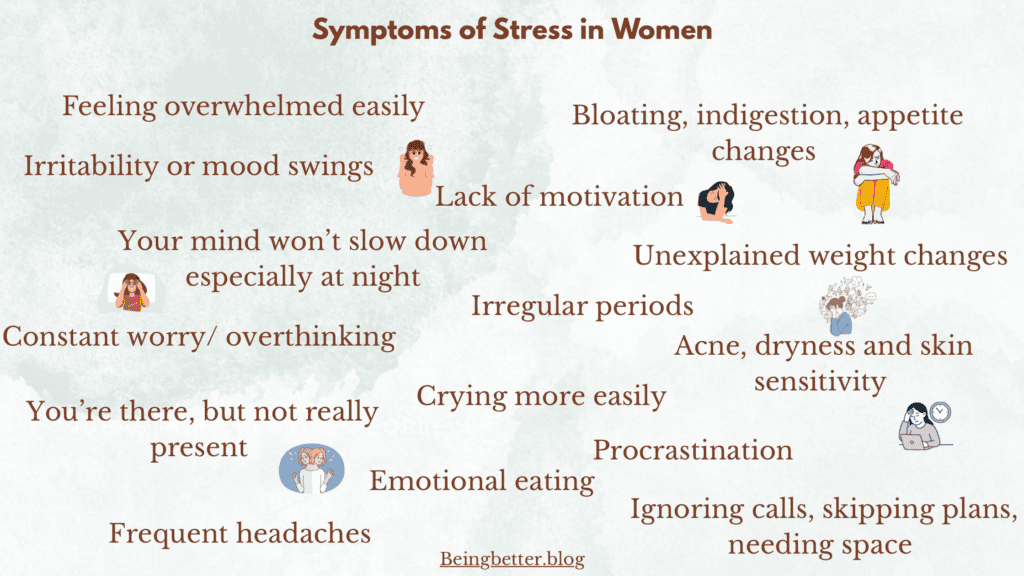
How Stress Specifically Affects Women
- Cortisol is released as a result of stress which would be interfering with reproductive hormones and causes irregular periods, PCOS, Endometriosis, thyroid imbalances etc.
- This will further results in many complications during pregnancy
- Women are more likely to affected by mental health challenges if stress is not managed properly. This is because of the continuous overthinking, self-criticism or emotional exhaustion.
- Also, as women are mostly showing up as caregiver roles resulting in not having enough time for themselves and this causes their losing motivation and interest in life.
- Disrupted sleep patterns and insomnia results in daytime fatigue
- Frequent headaches
- Neck and shoulders muscle tension
- Bloating, digestive problems
- Hair loss, Acne
- Mindless snacking ultimately leads to several health issues like diabetes, cholesterol etc.
- This also results in unexplained weight gain and hormonal imbalances
- Reproductive and sexual health would be affected as a result of PCOD, mood swings, fatigue, hormonal imbalances.
- Disrupted family relations
How to Manage Stress – 35 Realistic Tips
1. Pause instead of pushing through
When you feel overwhelmed, your first instinct is often to keep going and push through it.
I’ve noticed that doing this when you’re already mentally tired usually adds more stress and makes everything feel heavier.
Instead, give yourself permission to pause for a few minutes.
Sit quietly, take a few deep breaths, or simply step away from what you’re doing.
These small pauses can help your mind reset and make it easier to continue with more clarity and calm.
2. Practice slow breathing
When stress builds up, your breathing often becomes fast and shallow without you even noticing.
Simply slowing it down can help your body feel calmer almost instantly.
Try taking a slow breath in, holding it for a few seconds, and then exhaling gently.
Sometimes, calming your breath is the easiest way to calm your mind.
3. Write your thoughts down
When everything stays in your mind, it can feel heavier than it actually is.
A cluttered mind often creates more stress and overthinking than necessary.
Writing things down helps you release those thoughts instead of carrying them all at once.
You don’t need to write perfectly — just let everything flow onto the page.
I’ve also written a detailed article on journaling — a powerful habit of writing your mind down.
4. Accept that not everything can be controlled
Trying to control everything can quietly create a lot of unnecessary pressure.
There will always be situations that are simply outside of your control, no matter how much you try.
When you begin to accept this, your mind starts to feel a little lighter.
Instead of focusing on everything you can’t control, bring your attention back to what you can do.
This small shift can help you feel more calm and grounded.
5. Stop overthinking every situation
Overthinking often makes things feel bigger than they actually are.
For example, someone might reply late to your message… and you start wondering,
“Did I say something wrong?”
“Are they upset with me?”
But in reality, they might just be busy.
Replaying the same thought again and again only creates unnecessary stress.
Sometimes, choosing to move on instead of overanalyzing can make your mind feel much lighter
6. Replace negative self-talk with neutral thoughts
When you’re stressed, your mind can become very critical.
You might say things like,
“I can’t handle this,”
or “Everything is going wrong.”
But I’ve noticed this only adds more pressure.
Instead, try shifting to a more neutral thought, like,
“This is difficult, but I’ll handle it step by step.”
For example, if you’re overwhelmed with work, instead of thinking “I can’t do this,” you can remind yourself, “Let me just start with one small task.” and see the difference.
7. Allow yourself to feel emotions
Ignoring or suppressing emotions can slowly increase stress.
It’s okay to feel sad, frustrated, or tired sometimes.
I’ve noticed that when you allow yourself to simply feel it — without judging or forcing it away — it becomes lighter.
I think when emotions are accepted, they pass more naturally instead of building up
8. Reduce constant worrying about the future
You may find yourself imagining things that haven’t even happened yet.
Most of these worries never actually become real — but they still take up a lot of mental space.
Gently bring your focus back to today… to what you can do right now.
I think when you stay present, your mind feels calmer and more in control.
9. Don’t take everything personally
Sometimes we assume things are about us when they’re not.
For example, if someone seems distant or replies differently than usual, we may start thinking,
“Did I do something wrong?”
But people often act based on their own situations, stress, or emotions.
Not everything is about you.
When you slowly let go of this habit, it reduces a lot of unnecessary stress and overthinking.
10. Avoid information overload
Watching too many videos or reading too much advice can actually make things more confusing.
You may feel like you’re learning a lot… but at the same time, you don’t know where to start.
Instead of clarity, it often creates pressure to do everything at once.
It’s better to focus on a few things that truly make sense to you — and apply them slowly.
That way, your mind feels calmer and more in control.
11. Take breaks from your phone
Constant notifications and frequent scrolling keep your mind active all the time.
Sometimes, without realizing it, we get used to checking our phone again and again — almost like a habit or even a small addiction.
Taking short breaks from your phone, even for 15–30 minutes, gives your brain some real rest.
Over time, this simple habit can help you feel calmer and more focused.
12. Stop comparing your life with others
Everyone’s journey looks different.
But sometimes, we look at others and feel like we are behind or not doing enough.
This comparison only creates unnecessary pressure and dissatisfaction.
You start doubting your own progress, even when you’re doing well in your own way.
Gently bring your focus back to your life — your pace, your path.
13. Reduce multitasking
Doing many things at once may feel productive, but it often reduces focus and increases stress.
You might start one task, then switch to another, and by the end, nothing feels fully done.
This can make the mind feel more scattered and tired.
Instead, try focusing on one task at a time and completing it before moving on.
It feels calmer, clearer, and much more manageable.
14. Get enough sleep
Sleep affects your mood, focus, and overall energy more than we often realize.
When you don’t get enough rest, even small things can start to feel more stressful and overwhelming.
Even small improvements in your sleep routine — like going to bed a little earlier or reducing screen time at night — can make a noticeable difference.
Your mind feels lighter and more balanced when you are well-rested.
Read more on Effective sleep routines
15. Maintain a simple routine
A simple routine can make your day feel more stable and less overwhelming.
When you don’t have a structure, you end up making too many small decisions throughout the day — and that itself can feel tiring.
Even a basic routine, like fixed times for waking up, meals, or work, reduces mental clutter.
When your day has some structure, your mind feels calmer and less chaotic.
16. Eat regularly and properly
What you eat — and when you eat — affects your energy and mood more than you might notice.
When you skip meals or eat irregularly, you may start feeling tired, irritated, or low on energy.
Even simple, regular meals can help you feel more stable throughout the day.
It doesn’t have to be perfect — just consistent and balanced enough to support your body.
17. Drink enough water
Even mild dehydration can affect how you feel without you realizing it.
You might feel tired, low on energy, or unable to focus properly.
Something as simple as drinking enough water throughout the day can make a difference.
Keeping yourself hydrated supports your energy, focus, and overall well-being.
18. Include some movement
Movement helps release stress that builds up in your body.
When you stay inactive for long, your body can feel heavy and your mind feels more tired.
Even a short walk or a few minutes of stretching can make you feel lighter.
19. Seek support when you need it
Trying to handle everything on your own can feel exhausting.
Keeping everything inside only makes it feel heavier over time.
Talking to someone you trust — even a simple conversation — can help you feel lighter and more understood.
Spending time with supportive people also makes a difference.
You don’t have to do everything alone, and it’s okay to ask for help when you need it.
Sometimes, sharing is what brings the most relief.
20. Plan your day
A simple plan can make your day feel much clearer and more manageable.
When you don’t plan, everything feels scattered, and you may not know where to start.
I’ve noticed that having a to-do list ready for everyday morning reduces much confusion.
It gives you direction and helps you focus on what actually matters instead of feeling overwhelmed.
21. Break tasks into smaller steps
Big tasks can feel heavy and overwhelming, which makes it hard to even start.
When something feels too big, we tend to delay it or avoid it completely.
Instead, break it into smaller, simple steps.
Starting with just one small part makes it feel easier, and once you begin, it becomes much more manageable to continue.
22. Focus on one thing at a time
Trying to do everything together can quickly create stress and confusion.
You may feel busy, but at the same time, nothing feels fully done.
Giving your full attention to one thing at a time helps you stay productive without feeling overwhelmed.
23. Set realistic expectations
Expecting too much from yourself can quietly build pressure and frustration.
Sometimes we plan too many things in a day and feel disappointed when we can’t complete them all.
When expectations are realistic, things feel more manageable.
Set goals that feel achievable for your current time and energy — it helps you stay consistent without feeling overwhelmed.
24. Prioritize what matters
Not everything needs your attention at the same level.
Sometimes, trying to do everything at once can make you feel overwhelmed and scattered.
I’ve noticed that when I focus only on what truly matters in that moment, things feel much more manageable.
Give your energy to what is important right now — the rest can wait.
25. Accept that you cannot do everything
Trying to do everything at once can quickly lead to burnout.
Sometimes we put pressure on ourselves to handle everything perfectly, but that only makes things heavier.
Accepting our limits actually brings more peace.
It’s okay to leave some things for later — not everything has to be done today.
26. Spend quiet time doing something you enjoy
Constant noise and stimulation can make your mind feel overwhelmed without you even realizing it.
When I take a few moments to step away and sit quietly, everything starts to feel a little lighter and more manageable.
It doesn’t have to be anything big — even doing something simple you enjoy, like listening to music, journaling, or just sitting in silence, can help reset your mood.
Give yourself permission to slow down and enjoy small moments of calm.
27. Step outside
Staying indoors for too long can sometimes make you feel more overwhelmed than you realize.
Even a small change of environment, like stepping outside for a few minutes, can shift how everything feels.
Fresh air, a bit of sunlight, or even a short walk can help clear your mind and ease that heavy feeling.
It doesn’t have to be long — just giving yourself that break can make a real difference.
28. Listen to calming music
When your mind feels busy or overwhelmed, it can be hard to slow your thoughts down.
Listening to calming music can gently shift your mood and help you feel more at ease.
It doesn’t have to be anything specific — just choose something that makes you feel calm and comfortable.
Even a few minutes of soft music can create a sense of peace and give your mind a break.
29. Set healthy boundaries
Saying yes to everything can slowly overwhelm you.
That taking on too many responsibilities or trying to keep everyone happy can drain your energy without you realizing it.
It’s okay to say no when something doesn’t feel right or when you simply don’t have the capacity.
Be realistic about what you can handle, and make space for your own time without feeling guilty.
Protecting your energy is not selfish — it’s necessary.
30. Let go of perfectionism
Trying to make everything perfect can quietly add more stress than you realize.
When I focus too much on getting things “just right,” it often slows me down and makes even simple tasks feel overwhelming.
Things don’t have to be perfect to be meaningful or complete.
Allow yourself to focus on progress instead — even small steps forward are enough.
31. Stop trying to control everything
Trying to control every detail can feel exhausting, even if you don’t notice it at first.
Holding on too tightly to how things should go often creates more stress than the situation itself.
Some things are simply beyond your control, and accepting that can take a surprising amount of pressure off your mind.
It doesn’t mean you stop caring — it just means you allow space for things to unfold without forcing them.
32. Focus on what you can do today
Thinking about everything at once can quickly feel overwhelming.
You don’t have to figure everything out right now — even small steps taken today are enough.
Give your energy to what you can do in this moment, and let the rest wait.
Sometimes, focusing on today is all you need to move forward with more ease.
33. Accept slow progress
It’s easy to feel frustrated when things don’t move as quickly as you hoped.
Expecting fast results can sometimes make the journey feel heavier than it needs to be.
Progress takes time, and not every step will feel big or noticeable.
Even slow progress is still progress — it means you’re moving forward, even if it doesn’t feel like it yet.
Be patient with yourself and trust that small steps will add up over time.
34. Be kind to yourself
The way you speak to yourself matters more than you might realize.
Try to speak to yourself with a little more gentleness and understanding, the same way you would to someone you care about.
Self-kindness doesn’t mean ignoring mistakes — it means supporting yourself through them.
Sometimes, a softer inner voice can make everything feel a little easier.
35. Understand your stress patterns
Sometimes stress can feel random, but when you start paying attention, you may notice certain situations or moments that trigger it more often.
I’ve noticed that becoming aware of these patterns makes a big difference — whether it’s specific situations, times of the day, or even how you’re feeling physically.
You might also begin to recognize early signs like irritability, tiredness, or feeling mentally overwhelmed.
Catching these signs early gives you the chance to pause and take small steps before the stress builds up.
Being aware of your triggers and patterns isn’t about controlling everything — it’s about understanding yourself better so you can respond more calmly and intentionally.
Stress is part of life, but it doesn’t have to own you. With just a few small, loving steps each day, you can build your own peaceful rhythm. Think of these habits like tiny seeds—they grow slowly, but beautifully.
🌿 Start small. Stay kind to yourself. You’re doing better than you think.