Welcome to another article from Being Better!
Have you ever started something with so much excitement…
A new habit.
A routine.
A goal you really cared about.
For a few days, you feel motivated. You show up. You feel proud of yourself.
And then slowly… you stop.
You miss a day.
Then another.
And before you realize it, you feel like you’re back where you started.
I’ve felt this too.
Staying consistent is not always easy — not because we are lazy, but because we don’t always understand what actually helps us stay consistent.
So in this article, I want to share a few simple and practical tips that can help you stay consistent with anything you start — in a way that feels natural, not forced.
1. Start smaller than you think
Sometimes we start with big expectations.
We want to do everything perfectly, every single day.
But I’ve noticed that when something feels too big, it becomes hard to continue.
Start small.
Even 5 minutes is enough.
Even one small step matters.
Consistency grows from small actions, not big plans.
2. Keep it simple
You don’t need a complicated routine to stay consistent.
Sometimes we try to do too many things at once — a long routine, multiple steps, trying to do everything perfectly.
And after a few days, it starts to feel heavy.
When something feels too much, we slowly stop doing it.
Instead, keep it simple.
Choose one or two small things you can realistically do every day.
Something that fits easily into your routine.
For example, instead of saying,
“I will journal, visualize, and do affirmations every day,”
you can start with just:
“I will write for 5 minutes before bed.”
That’s it.
3. Limit the number of goals
Sometimes, we try to work on too many goals at the same time.
We want to improve everything — habits, routines, mindset, work, health… all at once.
When there are too many things to focus on, our energy gets divided.
And instead of being consistent in one thing, we end up being inconsistent in many.
So try to limit your focus.
Choose one or two important goals at a time — something you really want to stay consistent with.
I think when your focus is clear and not scattered, it becomes much easier to show up regularly.
4. Remember why you started
Sometimes, in the middle of everything, we forget why we even started.
The goal that once felt exciting slowly becomes distant.
When you lose connection with your reason, it becomes harder to stay consistent.
So take a moment to remind yourself.
Why did you begin?
What were you hoping to feel or achieve?
When you reconnect with that reason, even in a small way, it brings back a sense of clarity and motivation.
5. Focus on systems, not discipline
Sometimes we think consistency comes from strong discipline.
But I’ve noticed that relying only on discipline can feel tiring over time.
Instead, what really helps is having a simple system.
A system means setting things up in a way that makes it easier for you to show up.
For example,
Deciding a fixed time,
Keeping things ready in advance,
or following a small routine every day.
I think systems make consistency feel easier and more natural — not something you have to force every day.
6. Remove starting friction
Sometimes, the hardest part is just getting started.
If something feels like it needs too many steps to begin, we naturally delay it.
I’ve noticed this too — even small effort at the beginning can feel like a barrier.
So try to make starting as easy as possible by preparing things in advance.
For example,
You can make a simple to-do list the night before,
Keep your journal ready on your table,
Prepare your workout clothes and shoes,
or set up your workspace so everything is already in place.
When things are ready, you don’t have to think or arrange anything — you just start.
7. Decide the minimum version
This is one of my favorite ways to stay consistent.
I always keep a small, manageable version of my important daily tasks so I can show up even on low-energy days. 💛
Not every day will feel the same.
Some days you have energy. Some days you don’t.
On low-energy days, we tend to do nothing at all — and that’s where consistency breaks.
Instead of expecting the same effort every day, decide a minimum version of your task.
Something very small that you can still do even on your lowest days.
For example,
Instead of skipping completely, you can write just one line,
or take 2 minutes to reflect.
I think consistency is not about doing everything — it’s about not going to zero.
Even a small effort keeps you connected, and that makes it much easier to continue the next day.
8. Have a weekly reset day
Sometimes, we keep going without pausing to check how things are actually going.
When we don’t review, small mistakes or gaps keep repeating.
So try to have one day in a week as a reset day.
On that day, you can:
Review what you did during the week
Notice where you missed or struggled
Make small adjustments
Plan for the next week
It doesn’t have to be long or complicated.
I think this small weekly check-in helps you stay aware, feel more in control, and makes it easier to stay consistent over time.
9. Don’t rely only on motivation
Motivation comes and goes.
Some days you feel inspired and ready to do everything.
Some days you don’t feel like doing anything at all.
And that’s completely normal.
Consistency is not about how you feel — it’s about showing up even on the days you don’t feel like it.
I often think consistency becomes easier when we rely on a fixed time, not a fixed mood.
When you decide when you will do something, instead of waiting to feel like doing it, it slowly becomes a habit.
10. Allow imperfect days
This is very important.
If you judge yourself every time you miss a day, it becomes harder to start again.
You might think,
“I missed yesterday… now I’ve failed,”
and then you keep postponing it even more.
The more you blame yourself, the more you avoid coming back.
When you miss a day, don’t overthink it.
Just come back the next day and continue from where you left.
No guilt. No pressure to “make up” for it.
I think being gentle with yourself in this way makes consistency feel much easier — because you’re not afraid of missing, you’re just focused on returning.
11. Focus on the process, not just results
Sometimes, disappointment comes when we don’t see results quickly.
When nothing seems to change, we start to feel like our efforts are not working… and slowly, we stop showing up.
But I think it’s important to understand that consistent action is what actually creates results — even if we can’t see them immediately.
Not everything shows up right away.
Sometimes, things are slowly building in the background, even when it feels like nothing is happening.
And when you continue showing up consistently, you are already moving closer to your results — even if it doesn’t feel like it yet.
That’s why focusing only on results can make consistency harder.
12. Create an identity
Sometimes, consistency becomes easier when it’s not just something you do… but something you are.
Instead of thinking,
“I’m trying to be consistent,”
try shifting it to,
“I am someone who shows up.”
When you start seeing yourself in a different way, your actions slowly begin to follow.
You don’t have to prove it in big ways.
Even small actions — showing up for a few minutes, continuing after a break — help build that identity.
I think when you start becoming that person in your mind first, consistency starts to feel more natural, not forced.
13. Know your distraction triggers
Sometimes, it’s not just distractions… it’s what triggers them.
I’ve noticed this too — certain moments in the day automatically make you reach for your phone or lose focus.
For example,
When you feel bored,
When a task feels difficult,
or when you don’t know what to do next.
And without realizing it, you move away from what you planned to do.
So try to notice your patterns.
Ask yourself,
“When do I usually get distracted?”
“What am I feeling in that moment?”
Once you understand your triggers, it becomes easier to manage them.
14. Track your streaks
Sometimes, seeing your progress can be more motivating than you expect.
You don’t need anything complicated — even a simple calendar or habit tracker is enough.
You can mark a small tick, a cross, or just highlight the days you showed up.
When you see those small streaks building, it gives you a quiet sense of progress.
On days when you don’t feel like doing it, you may still show up… just because you don’t want to break that streak.
It’s not about being perfect.
It’s just a small way to remind yourself — “I am showing up.”
15. Use environment pressure
Sometimes, your environment can quietly influence your actions more than your motivation.
When you’re around people or situations where something feels expected, you naturally tend to follow through.
You can use this in a positive way.
For example,
Tell a friend about your goal,
Join a small group where others are also working on similar habits,
or even share your progress somewhere.
When you know someone else is aware of what you’re doing, you feel a gentle sense of responsibility to show up.
16. Reward yourself
When there is no sense of reward, it becomes harder to stay motivated.
So try to give yourself small rewards.
It doesn’t have to be anything big.
For example,
Take some quiet time for yourself,
Watch something you enjoy,
or simply appreciate yourself for showing up.
I think these small rewards create a positive feeling around your habit.
And when something feels good, you naturally want to continue it.
Pause and Reflect
Take a moment and gently reflect on this.
You don’t need to answer everything perfectly. Just notice what feels true for you.
- Where do I usually break my consistency?
- Am I trying to do too much at once?
- What is one small thing I can do consistently starting today?
- Can I make it simpler or easier for myself?
- When can I include it in my daily routine?
- How can I show up even on low-energy days?
That’s all dear Beauties…..
Staying consistent is not about being perfect.
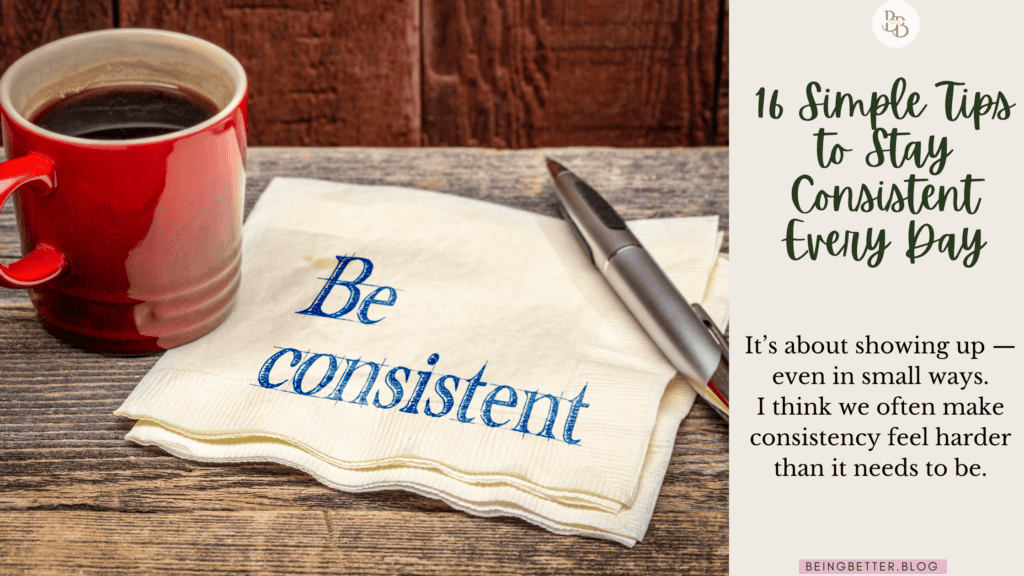
It’s about showing up — even in small ways.
I think we often make consistency feel harder than it needs to be.
But when you keep things simple, gentle, and meaningful, it slowly becomes part of your life.
And that’s when real change begins.